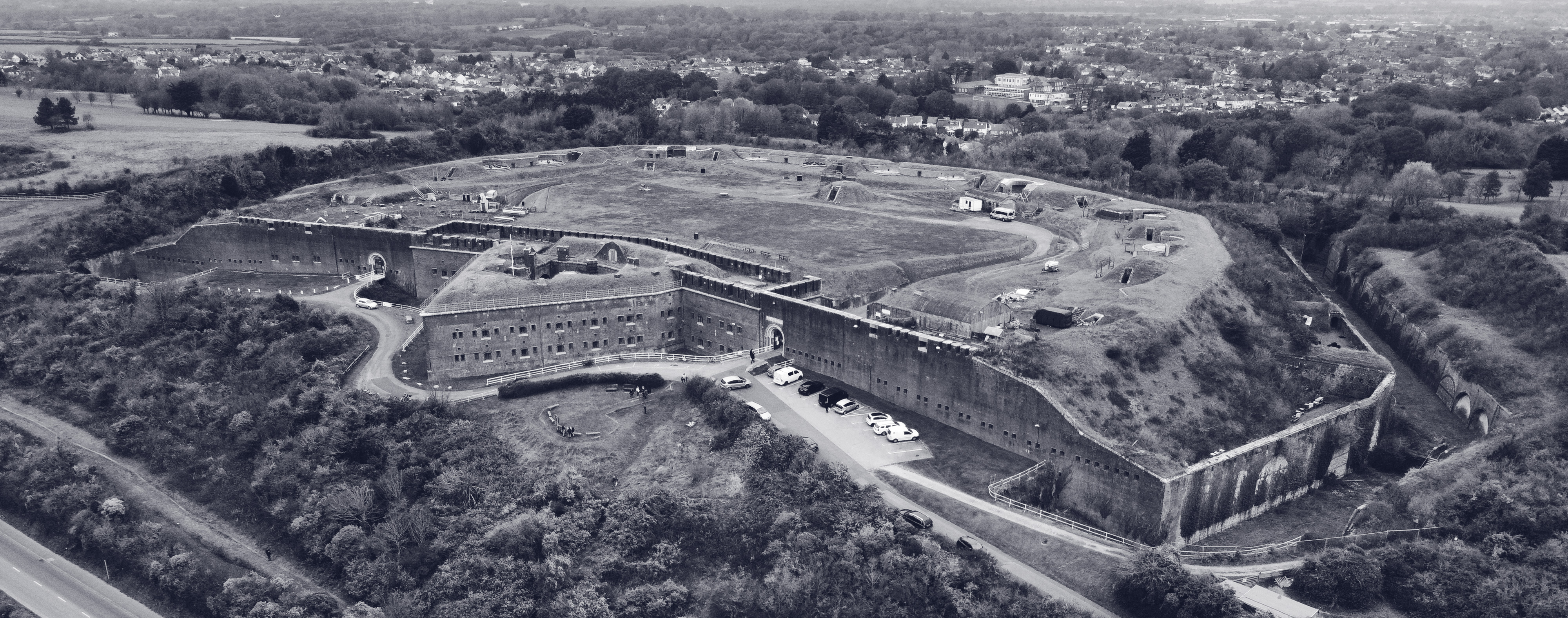
Fort Purbrook (our club's QTH) - pictured from above, facing North West.
Attribution: TimSC, CC BY-SA 4.0 https://creativecommons.org/licenses/by-sa/4.0, via Wikimedia Commons [original image].
Fort Purbrook is the most Easterly of the hilltop forts located along the ridgeline of Portsdown Hill at the north of Portsmouth. Travelling Westward along the top of Portsdown Hill, you reach Fort Widley, then Fort Southwick, Fort Nelson and finally Fort Wallington (now demolished, effectively the last of the hilltop Forts). The forts then continue through Fareham and Gosport and out into the Solent – the Sea Forts.
These forts, that encircle Portsmouth, were built as a result of the 1859 Royal Commission, which, under Lord Palmerston, authorised fortifications to be constructed to defend Portsmouth and its all-important Royal Navy Dockyard from an inland attack from Napoleon III and his French armies.
It is worth noting that, when in Portsmouth and looking towards the line of the Forts on the top of Portsdown Hill, you are actually looking at the rear of the Forts. The fronts face inland to the North.
As the threat from France never materialised, these fortifications became known as Palmerston’s Folly; they never saw action.
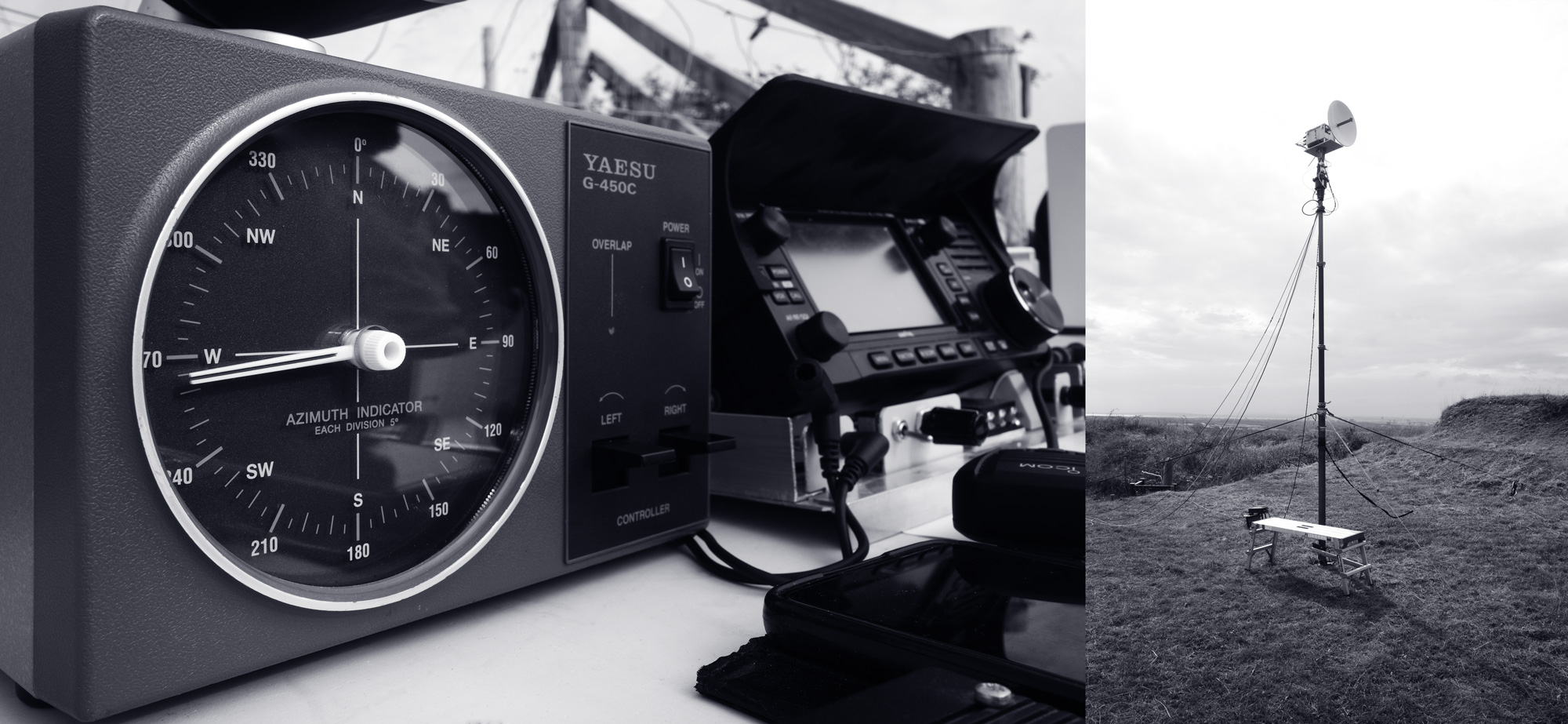
Some of the forts were used for anti-aircraft gun emplacements during World War II. Fort Purbrook, home to our Amateur Radio Club, hosted experimental Royal Naval radar antennas in 1947, that were installed on large concrete foundations on the Fort roof.
One of these concrete foundations supported our small 2m/70cm vertical antenna (Comet GP-1) in our earlier days.
The Palmerston Forts Society, which is based at Fort Nelson, have further information on these historic fortifications.
New to Amateur Radio?
>
How to get Started.